
GetBlock runs blockchain infrastructure at a scale that breaks normal operational models. We're talking 130+ blockchains (the biggest roster in the segment), over 1,000 physical servers spread across three data centers, and 35-40 billion requests monthly. Five of the Fortune Crypto Top 100 companies rely on them.
At that scale, managing infrastructure is a non-trivial, monumental task. It’s exactly why running nodes in-house is a nightmare for most Web3 teams. You are constantly balancing a node fleet spanning every supported chain, each with its own uptime math. A connection pool layer that behaves differently under every client's load pattern. A bare metal park spread across regions, each with its own cost and maintenance profile.
When you serve 60,000 active customers, twenty-four-hour uptime isn't a goal; it's a baseline. The engineering mandate is clear: client uptime and response quality over absolutely everything else. Which means ruthless prioritization. When engineers are focused on ensuring a node doesn't drop during peak load for a Fortune 100 client, internal cost optimization naturally falls to the bottom of the backlog.
Keeping all of it in view is the entire game. Most AI tools available today operate at a safe distance from this reality. They write code in IDEs, scaffold prototypes, and run inside sandboxes where the worst-case failure is a refresh.
GetBlock decided to find out what would happen if they let an AI agent operate inside the real thing.
In short: GetBlock did not deploy Ardor into its infrastructure or pre-build internal integrations for it. They simply gave Ardor the same production access a trusted employee would receive: VPN access and read-only credentials.
Once inside, Ardor explored GetBlock's systems, learned how the infrastructure was organized, and began building the internal tools and services it needed to complete real operational work, including blockchain node operations, internal dashboards, support workflows, ETL pipelines, databases and other production services.
This is what agentic operations looks like in production: an agent that enters an existing operational environment, builds its own understanding of the system, creates the tooling it needs, and acts on what it finds.
Why GetBlock put Ardor behind their VPN
Vasily Rudomanov, CEO at GetBlock, was clear about what he was looking for: an agent that could operate live systems the way a senior engineer operates them. He wanted it to hold real credentials, access real production data, and take action when action was warranted. Most AI tools on the market can’t do that. They lived too far from the system to be useful as operators.
That's a substantial trust bar. Giving any AI system live credentials and access behind a production VPN is the kind of decision that gets a security team into a meeting. Doing it across a production blockchain infrastructure environment is the kind of decision that gets you a longer meeting.
Vasily didn't deploy Ardor into GetBlock's infrastructure or build custom integrations for it. He gave Ardor what a trusted engineer would receive on day one: VPN access, read-only production credentials, and access to the live environment.
From there, Ardor mapped GetBlock's systems, learned how they worked, and built the internal tools and services it needed to complete real operational work. That included blockchain node operations, internal dashboards, support workflows, ETL pipelines, Metabase, and other production services. Rather than relying on pre-built integrations, Ardor created what it needed as it encountered new problems.
"Ardor is insatiably curious in the best way. You ask it one question, and it surfaces three things you didn't know you needed to know."
— Vasily Rudomanov, CEO, GetBlock
The decision was about leverage. GetBlock's operational surface is wide: blockchain node operations, internal analytics, dashboards, support workflows, marketing data pipelines, and more. The people who could meaningfully work across all of those layers were the same handful of senior engineers the company couldn't afford to spread thin.
By giving Ardor access to the same operational environment as those engineers, GetBlock wasn't just automating individual tasks. They were enabling an agent to build its own understanding of the environment, create the tooling it needed, hold context across the company's operational surface, and act on what it found. That was the kind of leverage they were looking for.
What Ardor does inside GetBlock's production stack day to day
Day to day, Ardor operates across the same set of systems a cross-functional senior engineer would touch. Except continuously, and across all of them at once.
On blockchain node operations, Ardor debugs Solana WSS connection issues, monitors out-of-compute-unit events, inspects failover spending, compares success rates across the fleet, and more.
Internal analytics is another layer. The agent works directly inside Metabase, resets access, investigates churn logic when the numbers don't match what the team expects, and explains datamart-versus-raw-data discrepancies to the CEO without anyone manually tracing the lineage.
Data pipelines are part of the day-to-day too. When the May 6 to 11 event window was missing data in Mixpanel, Ardor backfilled it and then deployed an hourly ETL to keep the gap from recurring. Subsequent sessions updated Google Ads landing-page attribution flows.
Support and ticket operations sit in the same workspace. Ardor links Jira and Zendesk, counts and classifies support tickets, and maps users to products, protocols, and geographies.
Ardor also ships working software. In mid-May, the agent built and deployed SitemapHQ end-to-end: a Next.js application with Prisma, a public view, an admin panel, import/export functionality, search, Mermaid mode, and the full deploy flow. From requirements to live deployment, behind the same VPN.
It didn't stop there. Someone from the content team with zero engineering background - but a perfect understanding of their team's pain - asked for a tool to plan and generate content across 11 different channels, strictly adhering to complex brand guidelines and a personalized voice. Ardor built that from scratch too. It handled the entire setup: frontend, backend, database, and a full K8s deployment, taking it from a plain-English request to a live production service.
The pattern is consistent across every one of these. The agent operates across whatever systems the question touches, and surfaces what it finds.
Eyes and ears
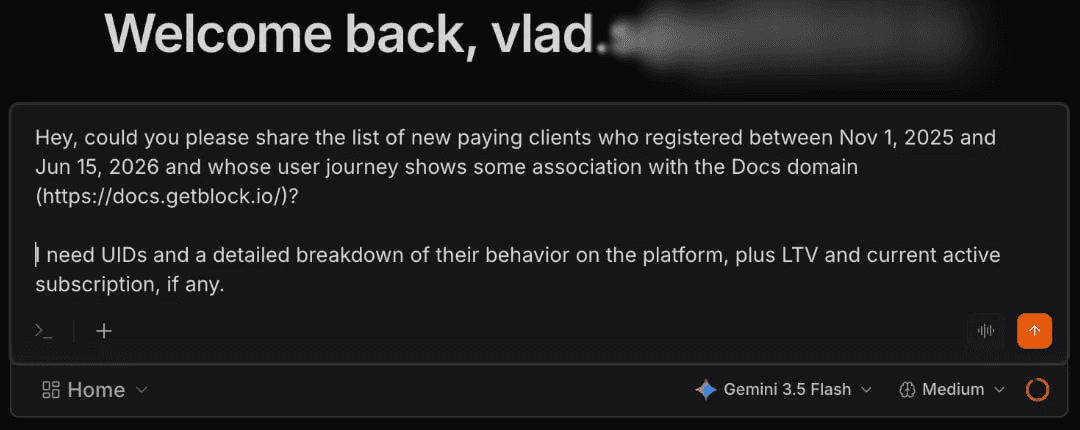
The technology has had its share of attention. What deserves equal attention is what Ardor does for the people who never open a terminal: business development, marketing, sales.
For those workloads it does one subtle, but radical thing: it lowers the bar.
Ardor connects to every instrument GetBlock runs to track what happens on its own site: who visits, how they move through the funnel, what they buy, where they came from, what brings them back. Wired into all of it, the platform becomes eyes and ears for anyone without an engineering background. Suppose you want to know whether the Docs section is working for client onboarding, and what you might change to improve it. You open Ardor and you ask.
This is an entirely new level of abstraction.
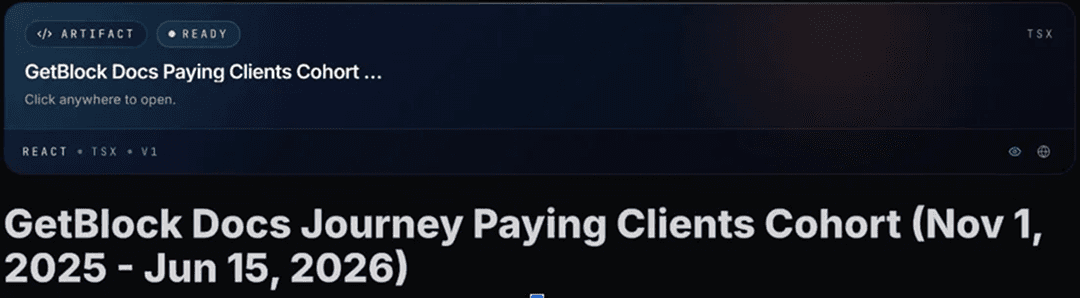
You no longer need Python or SQL. You no longer need to know what Arango, Metabase, Mixpanel, Google Analytics 4, or Ahrefs are, let alone how to query them. You no longer need to hold the map in your head: which numbers live here, which live there, who maintains the pipeline between them.
With Ardor you do not need to know that any of those systems exist.
The platform sits deep enough inside the marketing, analytics, and business-analysis data that an ordinary operator, whether a marketing generalist, a content developer, a technical writer, or a growth PM, can talk to it in plain English and pull whatever they need.
This is where the org chart starts to bend. In most companies data has an owner, and the owner is usually engineering. Everyone else files a request and waits for a dashboard. Marketing asks product for numbers, product asks analytics, analytics asks the warehouse.
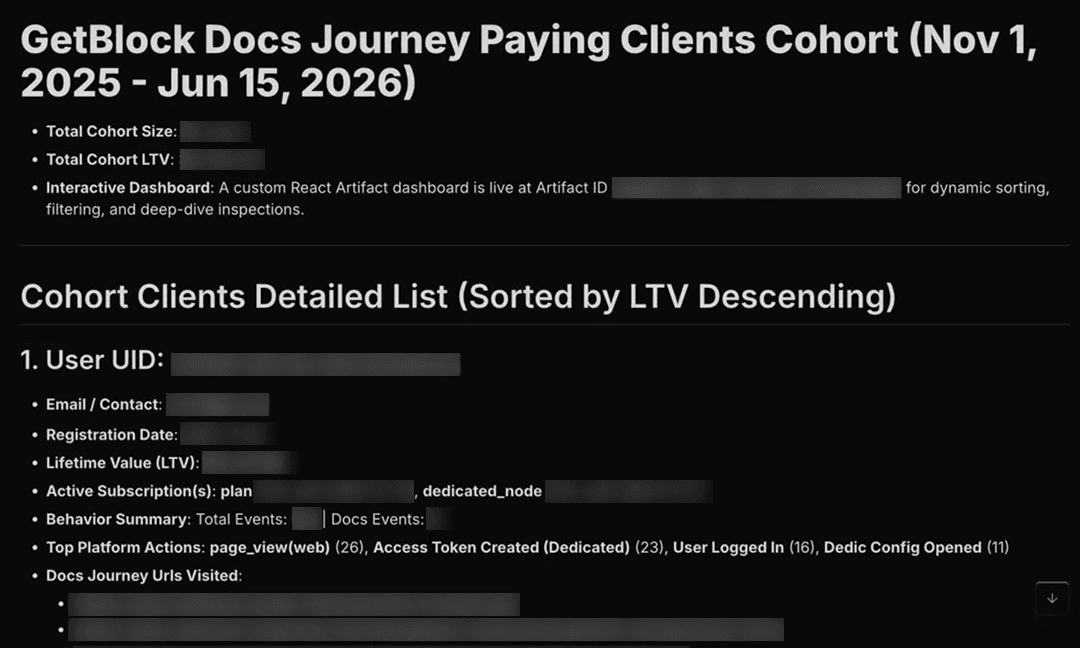
Ardor collapses that queue. When one system answers a marketer's question about onboarding and an engineer's question about latency with equal ease, the distinction between a product tool and a marketing tool no longer holds.
There is a single operational layer, and everyone speaks to it the same way.
A six-digit optimization nobody could imagine
The clearest illustration of what agentic operations means in production came when nobody was asking Ardor to do anything in particular - just a broad, open-ended prompt: "Explore our infrastructure and see what could be cost-optimized."
When a network spans 1,000+ servers and handles 40 billion requests a month, over-provisioning is a survival tactic. You never want to run out of capacity. But as networks evolve and client loads shift, some of that hardware naturally gets stranded. Your senior engineers shouldn't be spending their days manually auditing 1,000 servers to find zero-traffic nodes—they are busy keeping the connection up for your customers.
A team member asked the agent a routine question about GetBlock's infrastructure. The kind anyone running infrastructure asks dozens of times a week.
Given that single loose instruction, Ardor went to work. It pulled telemetry across the global fleet and cross-referenced billing data against actual RPC traffic.
By simply taking inventory of GetBlock’s bare metal servers, Ardor identified an uneven optimization surface.
The finance team received a decommissioning list that nobody had to manually build, cutting $360,000 in yearly costs.
The mechanic isn't complicated. The agent has access and context. It doesn't stop when the immediate question is answered. It does the deep-cleaning and optimization that humans shouldn't be wasting their time on when massive clients are depending on their uptime. It keeps looking at the operational surface it can see, and surfaces what doesn't make sense.
What this means for the category
Most AI dev tools your engineering team is evaluating right now do one of two things: generate code or generate apps. Both are useful in their domain. Neither operates at the layer where production systems actually live.
The next category, the wave after coding agents, is agentic operations. The agent runs behind your security perimeter with real credentials, operating against live systems. It self-heals where it can, surfaces issues where it can't, and asks for human approval before any destructive action.
GetBlock is the proof point. Live blockchain infrastructure, real credentials, real production data, real cost savings traced to behavior the agent took without being asked. This is what the operations layer looks like when it's actually running.
The job isn't to write code faster. The job is to notice what your team can't notice, because your team is busy.